How Do I Know If I Have an Ice Dam on My Roof? 7 Warning Signs Park City Homeowners Spot
How Do I Know If I Have an Ice Dam on My Roof? 7 Warning Signs Park City Homeowners Spot
Ice dams can be deceptively quiet killers. By the time water stains appear on your ceiling, the damage is often already in progress behind your walls and above your insulation. The good news is that there are several clear warning signs that appear well before serious water intrusion occurs — if you know what to look for.
This guide walks Park City, Utah homeowners through the seven most reliable indicators that an ice dam has formed or is forming on their roof, and explains what to do when you spot them.
What Makes Park City Roofs So Prone to Ice Dams?
Park City’s combination of heavy snowfall (300+ inches per season), dramatic freeze-thaw cycles, steep roof pitches, and complex architectural designs creates near-ideal ice dam conditions. Homes in neighborhoods like Deer Valley, Promontory, and the Canyons are particularly vulnerable because their elevation accelerates temperature swings.
Understanding the warning signs is the first line of defence.
The 7 Warning Signs of an Ice Dam on a Park City Roof
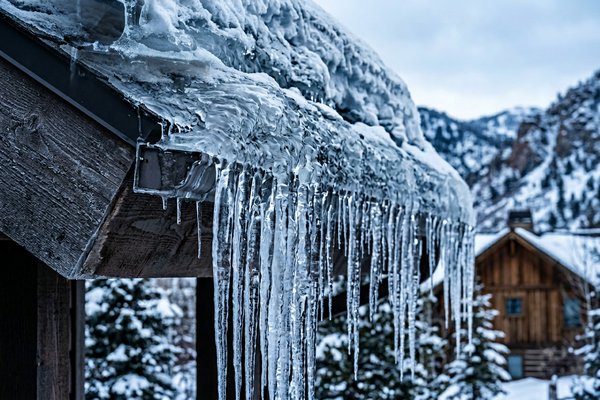
Warning Sign 1: Icicles Hanging From Your Eaves
The most visible early indicator. Icicles along the roof edge are not just decorative — they are a sign that meltwater is reaching the eave zone, where it has no drainage path and is refreezing. Large icicles or a continuous wall of ice hanging from the eave is a strong indicator that an ice dam has already formed above.
Important distinction: Small icicles after a brief melt may be harmless. Large icicles, icicle chains, or ice that appears to be building upward against the roof edge (not just hanging down) signals a genuine dam.
Warning Sign 2: A Clear Dividing Line in the Snow on Your Roof
Look at your roof from ground level or from a window. If you can see a section where the snow has melted back from the peak but remains thick at the lower eave area, that temperature differential is exactly what creates ice dams. The warm section (above the insulated living space) is melting snow; the cold section (the eave overhang) is refreezing it.
Warning Sign 3: Water Stains on Interior Ceilings or Walls
Any new ceiling stain during or shortly after a snowstorm — especially near exterior walls, around skylights, or along roof valleys — is a red flag. Water staining typically indicates that meltwater has already breached the roof plane and is migrating through insulation and drywall.
Do not wait for the stain to grow before investigating. By the time you can see the stain from below, insulation above may already be saturated.
Warning Sign 4: Peeling Paint on Interior Walls Near Exterior Surfaces
Paint bubbling, peeling, or blistering on ceilings or on walls adjacent to exterior-facing surfaces during winter is a classic sign of moisture infiltration from ice dam leaks. This symptom is particularly common in older Park City homes where interior paint was applied over earlier moisture damage.
Warning Sign 5: Damp or Wet Insulation in the Attic
If you have attic access, check the insulation above your exterior walls during or after a major storm. Wet or compressed insulation in the eave zone is a definitive sign that meltwater has entered the roof assembly. This is often the first place ice dam damage appears — before any visible interior sign.
Warning Sign 6: Gutters That Are Pulling Away From the Fascia
Ice dam formation creates enormous weight at the roof edge. As ice accumulates in and above gutters, it can cause gutters to pull away from the fascia board under the load. Gutter separation during winter is almost always ice-dam-related in Park City. Left unaddressed, this damages not just the gutter system but the fascia, soffit, and even the roof deck.
Warning Sign 7: Ice on the Exterior Wall Below the Roofline
If you notice ice forming on your home’s exterior siding below the roofline — especially in patterns that look like water has been running down the wall — ice dam overflow is the likely cause. Meltwater backing up behind the dam is overflowing the eave zone, running behind the gutter, and freezing on the wall. This indicates both active ice dam activity and potential damage to the wall assembly.
What to Do When You Spot These Warning Signs
| Situation | Recommended Action |
|---|---|
| Icicles only, no interior signs | Monitor closely; schedule inspection |
| Interior ceiling stain appears | Call for emergency assessment immediately |
| Wet attic insulation found | Emergency inspection + temporary tarping |
| Gutter pulling away | Stop using the gutter; professional assessment needed |
| Ice on exterior wall | Call 24/7 emergency line for same-day response |
Heat Tape Roofing™ offers true 24/7 emergency response for Park City homeowners. If you spot active water intrusion during a storm, do not wait. We can tarp affected roof areas the same day and prevent further water from entering your home.
➡️ Related reading: 24/7 Emergency Ice Dam & Storm Damage Response
Preventing Ice Dams From Forming in the First Place
Spotting warning signs early is valuable — but permanent prevention is far better. Professionally installed self-regulating heat tape addresses the root cause of ice dam formation by maintaining a clear melt path along eaves, valleys, gutters, and downspouts.
Heat Tape Roofing™ has protected Park City roofs for over 20 years with commercial-grade heat tape systems that activate automatically when temperatures approach freezing. Most Park City homes are fully installed within 2 to 4 days, and systems carry 5-year workmanship warranties plus 10 to 25-year product warranties.
➡️ Related reading: Professional Heat Tape Installation in Park City
Frequently Asked Questions
Q: Can I have an ice dam without visible icicles?
Yes. Ice dams can form hidden beneath the snow layer, with no visible icicle formation at the roof edge. The first sign may be an interior leak or wet attic insulation. This is why a post-season roof inspection is valuable even when everything appears fine from outside.
Q: How quickly do ice dams cause damage?
It depends on the severity and duration of the dam. A small dam over a single cold snap may cause no permanent damage. A large dam persisting for weeks can cause tens of thousands of dollars in interior damage, mold growth, and structural rot. Speed of response is critical.
Q: Is it safe for me to inspect my roof myself during a Park City winter?
No. Steep, snow-covered roofs are among the most common sources of serious fall injuries in Utah mountain communities. Heat Tape Roofing™ uses drone inspections as part of our Winter Prep service to safely assess your roof without anyone climbing on an icy surface. Do not risk a fall to check for ice dams yourself.
Act Fast — Early Detection Saves Thousands
Now that you know what to look for, make it a habit to check for these seven warning signs after every major Park City storm. And if you are ready to eliminate ice dam risk entirely with a professional heat tape system, Heat Tape Roofing™ is ready to help.
